
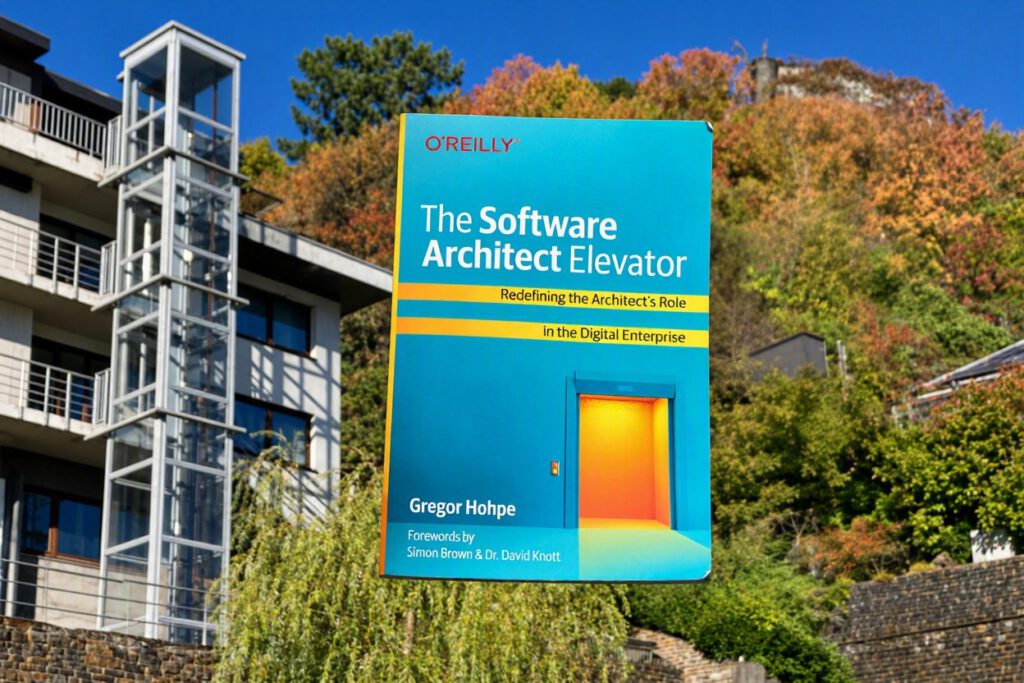
The Software Architect Elevator: Redefining the Architect’s Role in the Digital Enterprise
📢 Really enjoyed reading The Software Architect Elevator by Gregor Hohpe during our late-summer holidays in Germany.
The book was published in 2020, before the new AI wave, so it might seem a little “old” at first glance – but there are good reasons to read it now.
Since AI 🤖 is currently writing more code than humans, one could argue that AI is quietly turning engineers and developers into aspiring architects. That’s exactly why engineers should start learning about software architecture now: architects will need to guide AI agents in setting boundaries, identifying trade-offs, gathering requirements and so on. Those are architecture skills.
Gregor‘s book defines and explains the role of the software architect and responsibilities that come with it. It emphasizes, in particular that an architects task starts much before the architecture begins and the architect’s capability to communicate and convey ideas to people of different backgrounds (business and IT alike) and inspire them. The book is a great reminder of the real purpose and the importance of the role the software architect. With AI eating the world, this reminder feels more relevant than ever:
AI may make software architecture more important, not less
📗The Architect Elevator tells us that architects have to ride the elevator between the “engine room” (the technical reality) and the “penthouse” (business strategy, the management making the big calls) – not once, but repeatedly, translating in both directions to bridge business and technology.
⚠️Wthout that ride, one gets the classic ivory-tower problem: decisions made at the top with no feedback on whether they work in the engine room and engine-room work that never reflects on what the penthouse actually visions.
☝️In practice, this means an architect must be fluent in two languages: the strategic language of the penthouse, and the technical language of the engine room.
🏕️While we were spending a few days in the German village of Cochem, we came accross this beautiful glass elevator on a residential building, with the ancient Reichsburg Castle rising on the hill directly behind it. I had to take a picture (from the ground floor or the engine room, so to speak) and the scene had all the pieces of the Architect Elevator metaphor in one frame: an elevator, a tower, and a penthouse castle on the hill:
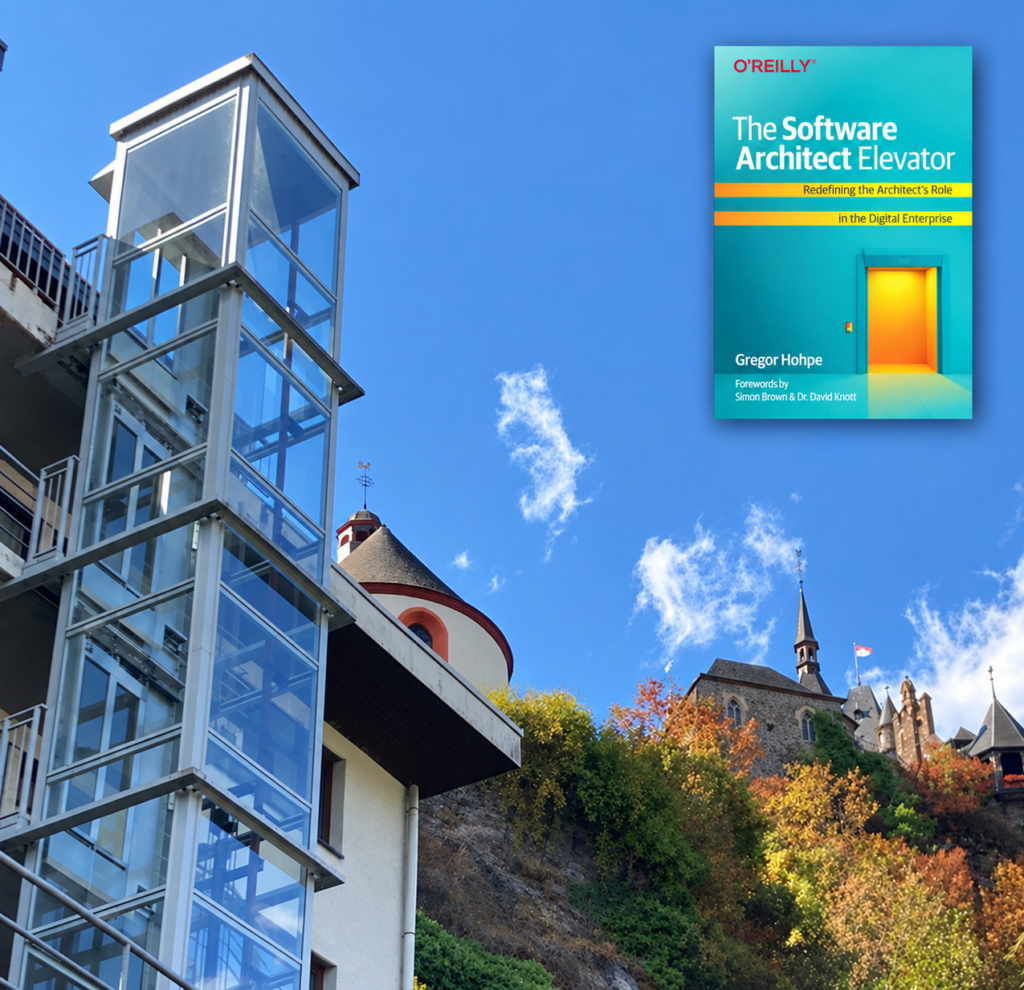
The elevator, ivory tower and the (castle) penthouse all lined up in Cochem, Germany
- The castle 🏰 is the penthouse: a fortress of perspective sitting high above Cochem, representing the strategic high ground
- The glass elevator 🛗 is the Architect Elevator, connecting that world with the engine room below. Its transparency felt fitting too: architects need to see the engine room clearly while moving upward. (As you can see, the elevator and the castle aren’t physically connected, but I hope the visual alignment is enough to activate the metaphor)
- And that little white tower in between? The ivory tower 😄 – what a penthouse becomes the moment you stop riding the elevator and stop engaging with the engine room
A few favorite takeaways from the book:
- Team IQ: an architect doesn’t have to be the smartest person in the room – their job is making everyone else on the team smarter
- Floors: the value of a modern architect can be measured by how many floors they span
- Organizations and systems: large complex organizations behave very similarly as to complex technical systems (organization floors = layered architecture)
- Trading options: good architecture is about spending some money and effort today so that you have more choices tomorrow to cope with uncertainty
- Metaphors: the books excels in using them – architects should do the same and use metaphors as a great means of inviting audience into the thought process
- Models: the book also excels in pictures. But don’t draw reality, sketch the mental model. A model does not have to reflect reality, but it should answer questions
🛗The above is all elevator work: moving between floors, translating, context switching, connecting penthouse and engine room and so on. AI is capable of riding some of those floors now. Is it only a matter of time before it handles more of the architecture work itself?
🫵Over to you: If AI starts architecting, what’s left for the architect? What comes to my mind: even more of the human work – communicating, aligning, trading options, navigating organizational politics and culture, and owning the why behind the decisions. Which is exactly why The Software Architect Elevator matters in the age of AI.
What about you….🤔?
Originally published on: Post | LinkedIn