AI is getting remarkably good at the HOW. That’s exactly why architects need to master the WHY.

AI is getting remarkably good at the HOW. It can generate code, propose architectures, compare design patterns, and automate implementation.That’s exactly why architects need to become even better at the WHY. If I could rename the role, I’d jokingly call it Problem Architect instead of Solution Architect. 🙂 Not because solutions aren’t important, but because

AI is getting remarkably good at the HOW. That’s exactly why architects need to master the WHY. Read More »

Software Architecture: The Hard Parts – Saga Comparison Matrix and Movie Analogies

I really enjoyed rereading Chapter 12 of Software Architecture: The Hard Parts by Neal Ford, Mark Richards, Pramod S. and Zhamak Dehghani (O’Reilly 2022) this May holiday🌞. That chapter is about Transactional Sagas, and I couldn’t resist turning it into a short post 🙂. The authors take the forces of communication, consistency, and coordination and turn them

Software Architecture: The Hard Parts – Saga Comparison Matrix and Movie Analogies Read More »

David Boyne’s EDA Visuals: Governance Enables EDA Freedom

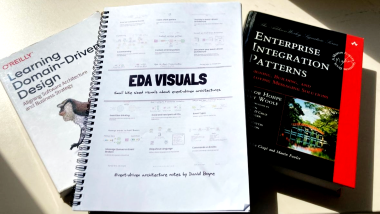
📢Just finished EDA Visuals by 🚀 David Boyne and it’s a must-read if you’re working with distributed systems. It’s especially valuable for visual learners like me🤓who prefer diagrams (less text, more pictures please 😊). 🌟 What stood out to me most in this guide is that governance is not an afterthought. As an event-driven landscape

David Boyne’s EDA Visuals: Governance Enables EDA Freedom Read More »

Architecture for Flow – Blending DDD, Wardley Map and Teams Topologies

Really enjoyed reading 𝐀𝐫𝐜𝐡𝐢𝐭𝐞𝐜𝐭𝐮𝐫𝐞 𝐟𝐨𝐫 𝐅𝐥𝐨𝐰 by Susanne Kaiser over the Christmas holidays. The book clearly shows that combining #teamTopologies, #wardleyMaps and #DDD creates a synergy far stronger than any of them could achieve on their own. The key lies in connecting three dots that often exist in isolation:💼 Wardley Mapping → map your landscape

Architecture for Flow – Blending DDD, Wardley Map and Teams Topologies Read More »

Scroll to Top