
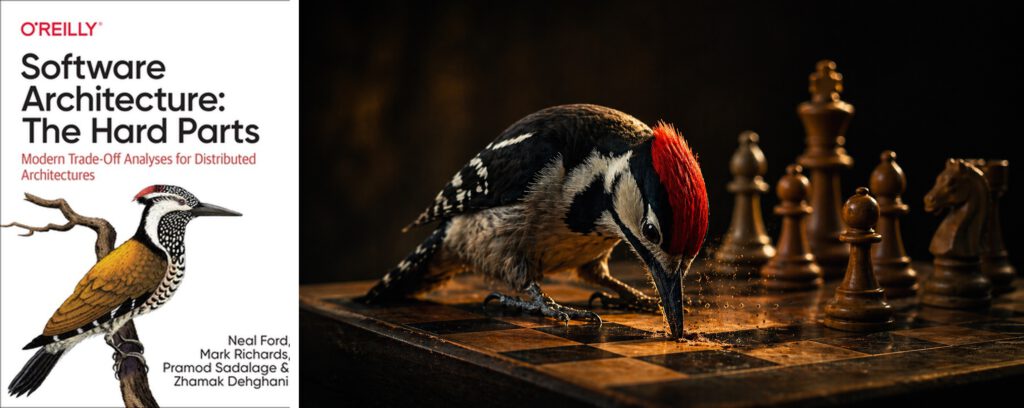
🪵 There’s a woodpecker on the cover of Software Architecture: The Hard Parts.
Probably just a coincidence. O’Reilly doesn’t pick cover animals based on the topic.
Still, I like the idea that it’s there for a reason.
A woodpecker keeps hitting the same hard spot until something gives. That reminded me of something from chess that I’ve been wondering about in architecture.
♟️ Chess players sometimes use something called the Woodpecker Method.
You take a batch of puzzles and solve them. Then you solve the same puzzles again. And again. The point isn’t really to memorize the answers. It’s to get better at recognizing the pattern, so you don’t have to work everything out from zero every time.
Architecture obviously isn’t like that.
There’s no absolute answer key. Two good architects can look at the same trade-off and make different decisions, and both can be reasonable in their context. And the problem itself changes. Come back to an architecture decision a year later and the constraints, priorities and context may all be different.
🔁 But I think there’s something useful in the idea of repitition.
We probably don’t get better at architecture just by making more decisions. Maybe we get better by looking back at old decisions and asking ourselves: would I make the same call today?
That only really works if you do it more than once or twice, though. Look back at a single old decision and you’re mostly just remembering the story. I wonder if doing it with ten or fifteen decisions would start to reveal something different – patterns rather than just memories.
🧭 I’ve been thinking about trying something simple:
- Keep a list of the real trade-offs I’ve made.
- Every few months, pick a few and make the decision again, without looking at what I actually chose.
- Then compare the two.
- And, where possible, ask someone who wasn’t involved how they’d approach it, then compare their reasoning to what actually happened.
The goal isn’t really to prove that my old decision was right or wrong.
I’m more interested in what I see now that I didn’t see then.
Maybe that’s one way pattern recognition develops in architecture. Not by seeing the same problem with the same answer, like in chess, but by seeing enough different versions of the same kind of problem.
Maybe the woodpecker is just decoration. But I like the reminder: some parts of architecture only become familiar after you’ve hit the same kind of hard problem a few times.
💬 What architectural decision looks different to you now than it did, say, a year ago?
Originally published on: Post | LinkedIn