
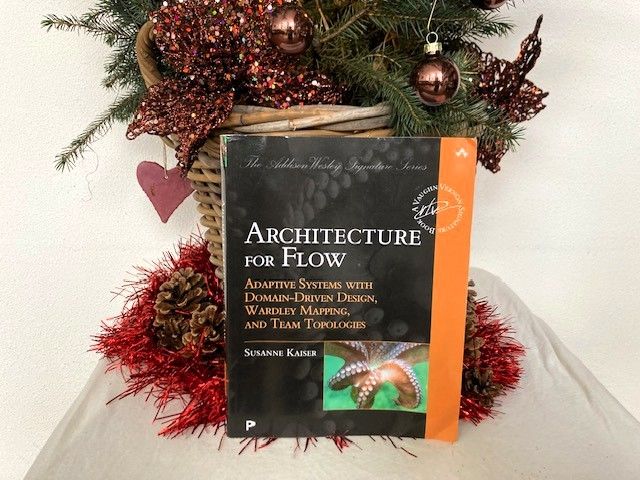
Really enjoyed reading 𝐀𝐫𝐜𝐡𝐢𝐭𝐞𝐜𝐭𝐮𝐫𝐞 𝐟𝐨𝐫 𝐅𝐥𝐨𝐰 by Susanne Kaiser over the Christmas holidays. The book clearly shows that combining #teamTopologies, #wardleyMaps and #DDD creates a synergy far stronger than any of them could achieve on their own.
The key lies in connecting three dots that often exist in isolation:
💼 Wardley Mapping → map your landscape and strategic options
🎨 Domain-Driven Design → define domains, boundaries, and models
👥 Team Topologies → structure teams and interactions for sustainable flow
You cannot change one without impacting the others.
What stood out for me most:
💡Connect the dots: adaptive systems thrive when business strategy, software architecture, and team design work together;
💡Start with what exists: understand current teams, interactions, and business landscapes before designing the future;
💡Visualize the future: map competitive landscape, prioritize investments, and modularize solutions to guide decisions;
💡Design integration around Bounded Contexts: focus on bounded contexts and subdomains to keep domain models cohesive and evolvable;
💡Design for flow: structure teams and interactions to maximize learning, feedback, and adaptablity;
💡Use structured tools: tools like the 𝐀𝐫𝐜𝐡𝐢𝐭𝐞𝐜𝐭𝐮𝐫𝐞 𝐟𝐨𝐫 𝐅𝐥𝐨𝐰 𝐂𝐚𝐧𝐯𝐚𝐬 optimize a system for flow by combining Wardley Mapping, DDD, and Team Topologies into a single, cohesive view;
🤔The book also briefly mentions 𝐈𝐧𝐭𝐞𝐫𝐜𝐡𝐚𝐧𝐠𝐞 𝐂𝐨𝐧𝐭𝐞𝐱𝐭𝐬, a concept I am very intrigued by. Interchange Contexts are specialized contexts that actively translate between bounded contexts rather than just sharing vocabulary. Often built using a Published Language pattern. More details in my article: https://lnkd.in/eykYgttW
🐙 And the octopus on the cover? A brilliant metafor that adaptive systems behave like living organisms: smart, flexible, and made of semi-autonomous parts that flow with a changing environment. The Vaughn Vernon Signature Series intentionally uses organic imagery to show that software systems should evolve naturally, not be rigidly engineered.
‾‾‾‾‾‾‾‾‾
👉If you’re a software architect or tech leader, this book belongs on your reading list.
Originally published on: https://www.linkedin.com/posts/tondonker_teamtopologies-wardleymaps-ddd-activity-7414305254869073920-ztPD/