
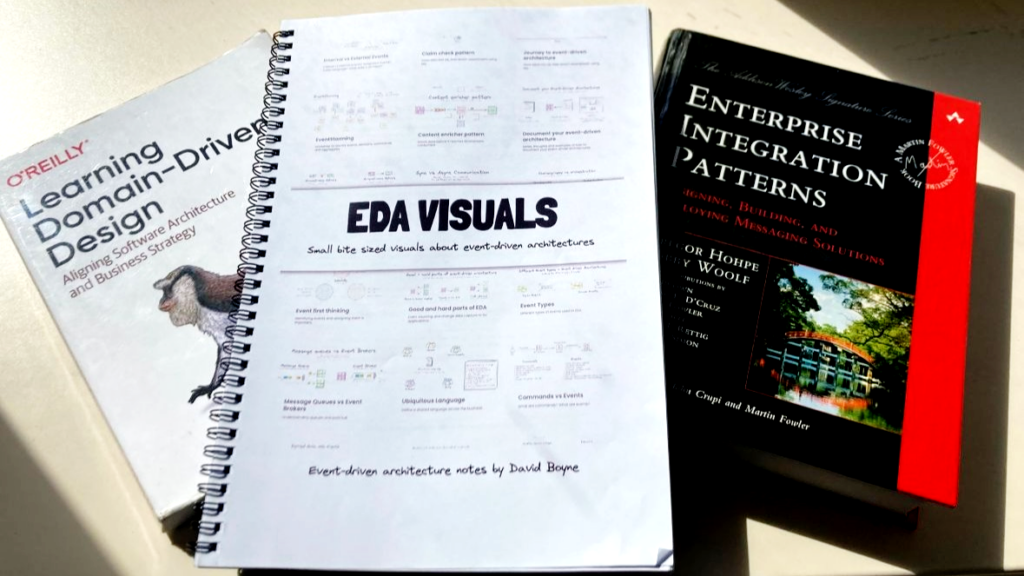
📢Just finished EDA Visuals by 🚀 David Boyne and it’s a must-read if you’re working with distributed systems. It’s especially valuable for visual learners like me🤓who prefer diagrams (less text, more pictures please 😊).
🌟 What stood out to me most in this guide is that governance is not an afterthought. As an event-driven landscape grows, you need clarity on ownership, available events, their usage, and how teams can discover them. Without governance, EDA can quickly become harder to understand than the tightly coupled system it was meant to replace.
A few takeaways I found especially relevant:
- Events need clear meaning and consistent naming, otherwise shared understanding breaks down
- Event design is a core part of an EDA application
- Documentation is part of the architecture, not separate from it
- Standards aren’t bureaucracy; they’re what make scaling possible
- ‘Producers don’t know consumers’ doesn’t mean ‘no governance’ – it means governance matters more than ever
- The more distributed the architecture becomes, the more critical eventual consistency, idempotency, and traceability become
- Event-driven architecture works best when teams treat events as first-class business concepts, not just technical messages
The guide also builds on foundational books from the field, positioning them as essential tools for navigating the complexity of eventdriven architecture:
Vlad Khononov‘s Learning Domain-Driven Design – the guide states: “Domain-driven design and EDA go hand in hand.” Bounded contexts, shared language, and domain discovery are treated not as theory but as practical tools for keeping event-driven systems understandable and reducing accidental coupling
Gregor Hohpe‘s Enterprise Integration Patterns – described in the guide as “a must read if you want to learn more” about messaging and integration. Patterns like Competing Consumers, Content Enricher, Idempotent Receiver and Claim Check are not academic exercises – they solve real problems that appear as soon as your EDA landscape starts to grow
👉🏻My key takeaway: good EDA isn’t just about freedom to change – it’s about having enough structure to scale that freedom responsibly. Too many teams treat EDA as ‘freedom’: freedom to publish events, freedom to move fast, freedom to decouple. But what this guide makes very clear is that without governance, that freedom quickly turns into chaos.
🎯Event-driven architecture without governance = distributed chaos.
🎯With governance = platform for change.
Good EDA governance isn’t about bureaucratic central control. It’s about a federated approach: shared standards, explicit ownership, and making the architecture discoverable for everyone. Governance is the enabler of EDA freedom.
🙏Thanks to 🚀 David Boyne for making the EDA Visuals freely available. Also worth calling out: his open-source project EventCatalog – this is exactly what EDA governance looks like in practice. It helps teams document events, define ownership, and make the architecture discoverable. Worth exploring.
Originally published on: David Boyne’s EDA Visuals: Governance Enables EDA Freedom | LinkedIn